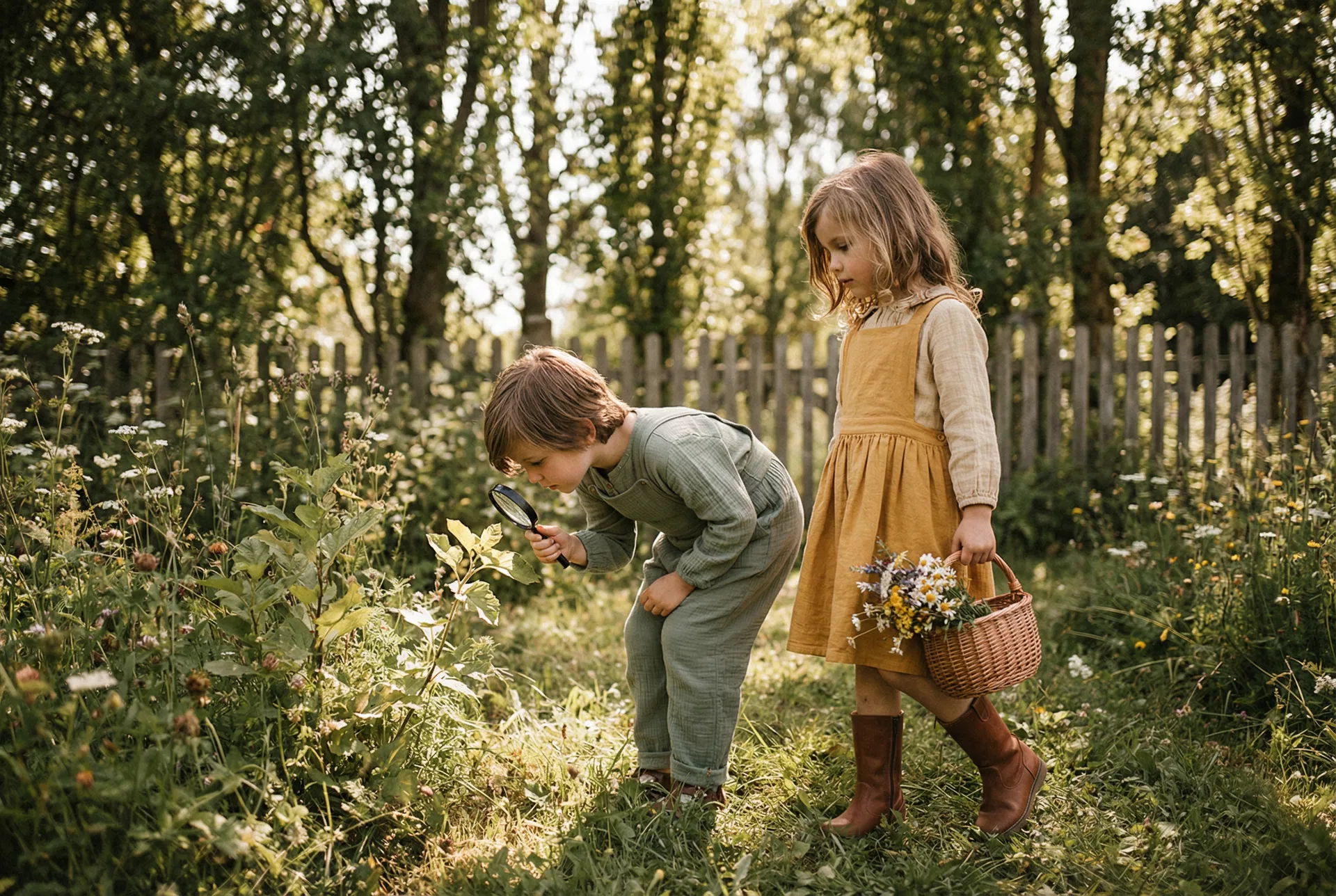
Why Nature-Based Learning Is Essential for Children
A growing body of research confirms what many parents intuitively know: time in nature is profoundly beneficial for children's physical, mental, and cognitive development. A 2024 meta-analysis published in the journal Nature and Health found that children who spend at least 2 hours per week in natural settings show reduced anxiety, improved attention, better academic performance, and stronger immune function.
Nature-based learning also develops skills that are difficult to teach indoors: risk assessment, resilience, patience, and ecological thinking. When children observe a caterpillar transforming into a butterfly or watch seeds they planted grow into flowers, they develop a deep understanding of life cycles and interconnection that no textbook can replicate.
Spring Activities: Growth and Renewal
Spring is the perfect season for hands-on biology. As the natural world awakens, children can observe and participate in the cycle of growth and renewal.
Start a Kitchen Garden
Even a small windowsill garden teaches children about plant biology, responsibility, and the food cycle. Start with fast-growing, forgiving plants: cress, radishes, sunflowers, and cherry tomatoes. Let your child choose what to plant, prepare the soil, sow the seeds, and take responsibility for watering. Keep a growth journal with measurements and drawings.
Summer Activities: Exploration and Adventure
Long summer days and warm weather create ideal conditions for extended outdoor exploration. Summer activities can be more ambitious and adventurous.
Create a Wildlife Survey
Turn your garden or local park into a research station. Help your child create a simple survey form to record the wildlife they observe: birds, insects, mammals, and plants. Use field guides or identification apps to name species. Over the summer, track how the wildlife population changes and discuss why certain species appear at certain times.
Seasonal Nature Activities Calendar
Plan your year of nature activities with this seasonal overview.
| Season | Key Activities | Skills Developed | What to Observe |
|---|---|---|---|
| Spring (Mar-May) | Seed planting, tadpole watching, bird nesting | Patience, responsibility, biology | Buds opening, birds building nests, longer days |
| Summer (Jun-Aug) | Wildlife surveys, rock pooling, camping | Observation, identification, resilience | Insect life cycles, wildflowers, constellations |
| Autumn (Sep-Nov) | Leaf collecting, conker crafts, foraging | Classification, creativity, ecology | Colour changes, migration, seed dispersal |
| Winter (Dec-Feb) | Bird feeding, frost patterns, star gazing | Empathy for wildlife, pattern recognition | Animal tracks, frost crystals, winter constellations |
How much time should children spend outdoors each day?
Health experts recommend at least 1-2 hours of outdoor time daily for children. However, even 20-30 minutes of quality outdoor time provides measurable benefits. The key is regularity — daily outdoor time, even in less-than-perfect weather, builds resilience and a lasting connection with nature.
What if we live in a city with limited green space?
Nature is everywhere, even in urban environments. Window boxes, balcony gardens, local parks, and even pavement cracks where plants grow all offer learning opportunities. Many cities have community gardens, nature reserves, and urban farms. Bird watching can happen from any window, and cloud observation requires only sky.
Is it safe for children to explore nature unsupervised?
This depends on the child's age, the environment, and your assessment of risks. Young children should always be supervised outdoors. As children grow, gradually increase their independence in familiar, safe environments. Teach them to identify common hazards (stinging nettles, uneven ground, water) and establish clear boundaries about where they can explore.
Nature & Outdoors Activities & Worksheets
Put what you have learned into practice with these free printable activities designed to complement the topics covered in this article.
Nature Scavenger Hunt Checklist
EasyThis printable scavenger hunt transforms any walk into an adventure of discovery. Children search for specific natural items — from different leaf shapes to animal tracks, textures, and sounds. It sharpens observation skills, builds nature vocabulary, and creates a genuine connection with the outdoor world.
Seasonal Nature Journal Pages
EasyA set of four seasonal nature journal pages (spring, summer, autumn, winter) where children observe and record what they see, hear, smell, and feel in nature. Each page includes guided prompts, a drawing space, and a species checklist.